



What is a Foundation?
A foundation is a structural element that transfers loads from a building to the ground, ensuring stability and support. Foundation systems are chosen based on the type of structure, soil conditions, environmental factors, and seismic activity.
Foundations are broadly classified into two categories:
Shallow Foundations: Transfer loads to the soil near the surface.
Deep Foundations: Transfer loads to deeper, stronger soil layers by bypassing weaker upper strata.
2. Types of Shallow Foundations
2.1. Strip Footing (Continuous Footing)
A common and economical type, where reinforced concrete runs continuously under load-bearing walls.
Advantages:
Suitable for low-rise buildings.
Simple and fast to implement.
Minimal material usage.
Disadvantages:
High settlement risk in soft soils.
Poor water resistance without proper drainage.
Applications:
Detached houses
Garden residences
Agricultural structures
2.2. Isolated Footing (Pad Foundation)
Individual concrete pads placed under each column of the structure.
Advantages:
Cost-effective for small buildings.
Easy to construct.
Disadvantages:
Limited load distribution capability.
Sensitive to soil variation.
Applications:
Sheds, small offices, storage areas
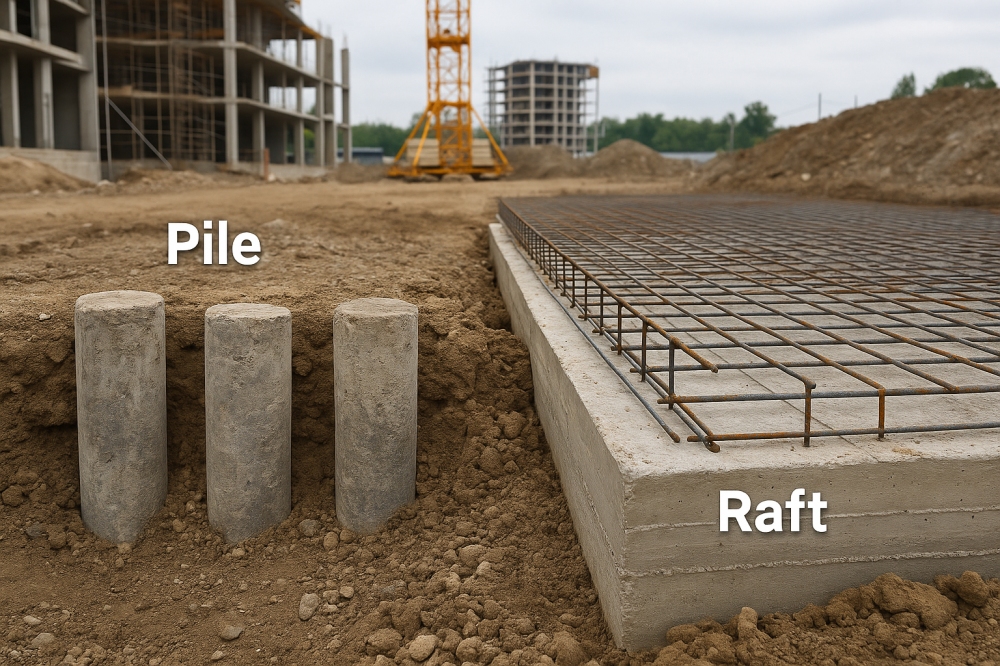
2.3. Raft (Mat) Foundation
A thick, reinforced concrete slab covering the entire footprint of the structure.
Advantages:
Even load distribution
Effective on weak soils
High earthquake resistance
Disadvantages:
Expensive due to materials
Requires skilled labor and site preparation
Applications:
Apartment buildings, commercial facilities, schools
3. Types of Deep Foundations
3.1. Pile Foundation
Used in weak or saturated soils, transferring loads to deeper, load-bearing strata via vertical elements called piles.
Types of Piles:
Driven (precast) piles
Bored piles
Mini piles
Advantages:
Suitable for high-rise and heavy buildings
Minimizes settlement risks
Disadvantages:
Expensive
Time-consuming to install
Noise and vibration concerns
Applications:
Skyscrapers, coastal structures, bridge piers
3.2. Caisson Foundation
Large, box-shaped foundation units placed in deep excavations, often underwater or in soft soils.
Advantages:
Stable for deep foundation needs
Used in marine and hydraulic structures
Disadvantages:
Complex installation
Requires extensive site work
Applications:
Dams, tunnels, port infrastructure
4. Comparison: Shallow vs Deep Foundations
| Feature | Shallow Foundation | Deep Foundation |
|---|---|---|
| Depth | 0.5 – 1.5 m | 5 – 50 m |
| Cost | Lower | Higher |
| Soil Condition | Firm, load-bearing | Weak, soft, filled soils |
| Structural Load | Light to medium | Heavy structures |
| Construction Time | Short | Long |
5. 7 Key Factors in Choosing a Foundation Type
Soil Investigation: Always begin with a geotechnical report.
Building Type & Height: Shallow foundations may be insufficient for tall buildings.
Seismic Risk: In earthquake-prone zones, raft or pile foundations are preferred.
Groundwater Level: Requires drainage and waterproofing if high.
Climate & Frost Depth: Foundation depth should exceed frost line.
Budget: Cost efficiency affects the choice.
Construction Timeline: Deep foundations extend the schedule.
6. Frequently Asked Questions (FAQ)
Which type is more durable: shallow or deep foundation?
Both can be safe if properly designed. The soil condition is the key factor.
Can raft foundations be used on all soils?
No. Piled foundations are better on extremely soft soils.
Which is more expensive: pile or raft foundation?
Generally, pile foundations cost more but depend on soil and structure.
Is soil testing mandatory?
Yes. As of 2025, soil investigations are legally required for permitted projects.
How long does pile foundation installation take?
On average 1–4 weeks, depending on the pile type and site.
7. Conclusion & Expert Tips
Selecting the right foundation system is one of the most critical engineering decisions in construction. An incorrect foundation design can compromise the structural integrity of an entire building.
Key Takeaways:
Soil investigation is essential.
Assess building type, local codes, and budget together.
Work with professional structural engineers to avoid errors.
In earthquake-sensitive regions like Antalya, foundation design is even more vital. A well-designed foundation is the first step toward a safe, resilient structure.
Let us help you determine the most suitable foundation solution for your project. Contact us for professional analysis, soil testing coordination, and structural consulting.
LATEST NEWS
-
 May 23, 2026
Soil Investigation
-
 April 30, 2026
What Is a Bored Pile?
-
 March 28, 2026
What is a Raft (Radye) Foundation?